

Industry moves with
predictability.
Romper supports the setup of those who already have a factory: numbers, licenses and timelines mapped before the first machine moves.
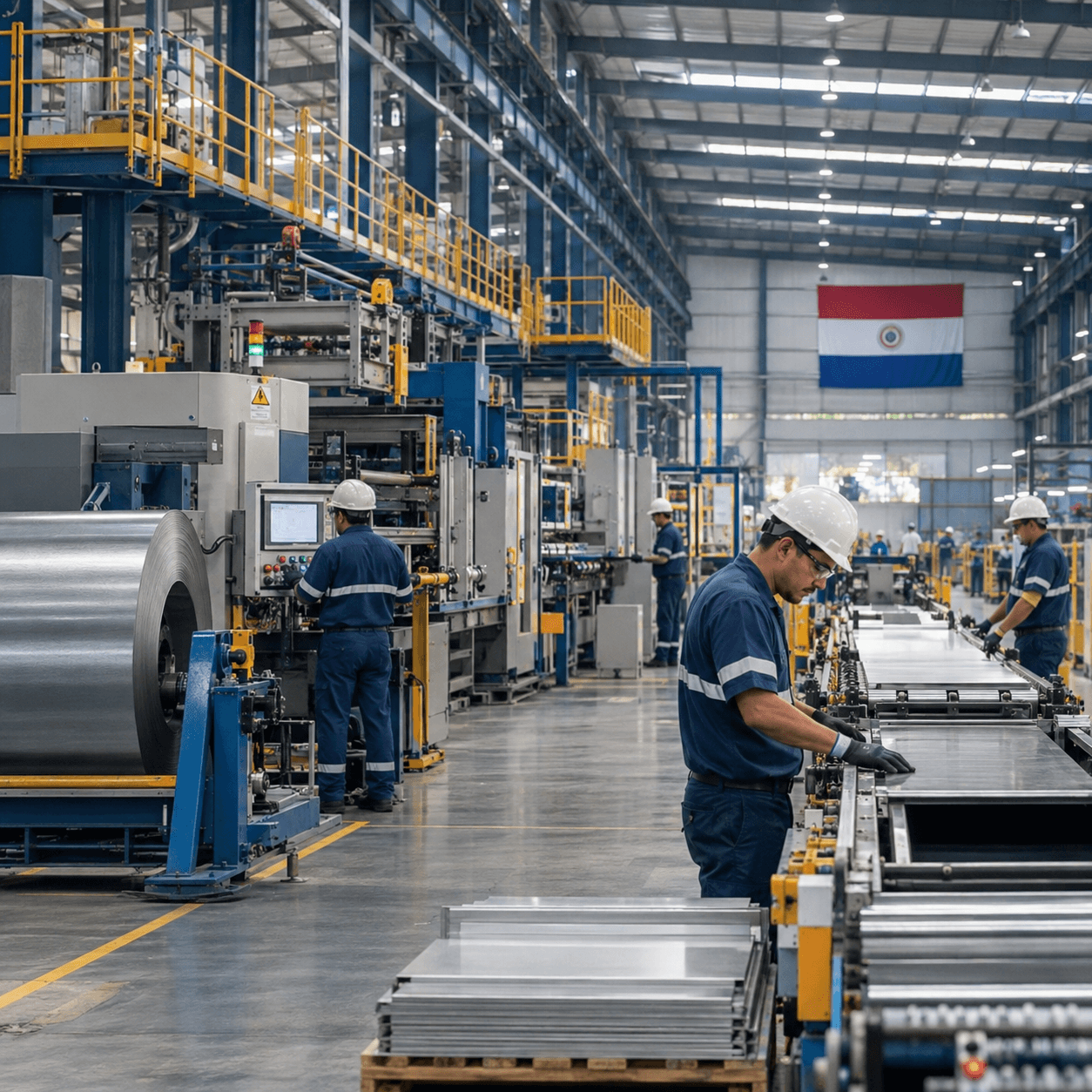
Three stages,in this order.
Each stage exists to make the next one predictable. Whoever starts with the last one pays the bill twice.
50 minutes on YOUR case: whether Paraguay fits, in what order and with what expectation. You leave with a decision, including the decision not to come.
The whole operation in scenarios: Mercosur origin and NCM, regime, licenses, logistics, capital and schedule, with a written verdict. Delivered in 45 business days.
Licenses, agencies, regime and documentation run by our team, with you in command of the factory, from the first day to the last.
Whoever already has their own diagnosis (and sometimes knows their own sector better than any consultant) goes straight to stage 3. Romper's diagnosis is not mandatory: it is the path for those who want the numbers checked by people who live here.
The investments for each stage (and the payment methods) are published at the end of this page, like everything at Romper: the price on the screen.
Paraguay is a place foroptimization.
Here you maximize profit, cut cost and optimize what already works. That is why we work with industry that already exists: those who have a factory in their home country and want to bring over a line, a stage or the entire production.
Whoever already produces knows how much the equipment costs, knows how to run it, knows where the raw material comes from and knows their own margin. That project has predictability, and predictability is what makes a setup finish.
Romper does not work with a new idea. A project that has not produced anywhere yet has no measured equipment cost, no mapped raw material and no known margin, and that is exactly what a setup lives on. Testing a model calls for a place where mistakes are cheap; Paraguay rewards those who arrive with the process mastered.

Seven out of ten projectsleave here with a no.
It is not a whim, it is what sustains the delivery of those who get in. There are six criteria, with both sides on the table, and the answer comes in the first conversation: never in the middle of the build.
Two rejections do not belong on this list because they stand on their own, and they are right below: a third party's project stalled halfway and any route outside the law. In those two there is no exception, and Romper's waiting list exists precisely because the list exists.
Those who filter like this,build here.
The Romper Group runs the largest operation for those who settle in Paraguay: +6,000 clients, own headquarters in Greater Asunción, Romper's own team and fleet.
And it speaks about industry hands-on: the group itself is setting up its own factory. The licenses, the agencies and the timelines on this page are our day-to-day with our own capital, not consultant theory.
The group also owns IndustriaPY.com, a directory and map of Paraguayan industry, and a channel that 700,000 people follow, where the same nos on this page are said in public, with a name and a face.
The six bottlenecksthat decide a project.
It is not the machine that delays a factory in Paraguay, it is these six points, each with its own agency, criterion and calendar. It is on them that the Diagnosis focuses, and it is on them that the implementation support works every day.
Mercosur origin: the NCM before anything
Does the product qualify as originating? The rule per NCM requires a tariff shift or a regional value-added percentage, with a documentary trail for each input. Getting it wrong here does not delay: it invalidates the model; the goods enter Brazil paying import duty and the case that motivated the move disappears.
Land use: the warehouse gate
Before the lease or the deed comes the land-use report (informe de uso de suelo) and the municipal permit: each ordinance defines what can operate in each zone, and an atypical height or noise change the answer. This is where the classic “warehouse in the wrong place” is born.
Environmental license: the real clock
Depending on the impact, the path is a DIA or an EIA through the MADES system. The stated timeframe is weeks; in practice, 6 to 18 months for an industrial operation, and each observation from the reviewer restarts part of the count. It is the main reason for the 18-month timeline.
Energy: power, not tariff
Paraguayan energy is competitive; the problem is getting it to your door. Contracted power, the capacity of the nearest substation and the line extension define cost and schedule; a high load also requires a specific classification with ANDE.
Regime: approved before exporting
General regime with a Mercosur certificate, maquila (Law 7547/2025) or incentives (Law 7548/2025): each with its own program, registration and timeline, processed through the MIC single window. A regime chosen after the machine is bought costs rework.
Customs: the asset stuck at the border
Importing a machine requires correct classification, a customs regime consistent with the project and registration in the single windows (VUI/VUE), today with a digital customs declaration. A wrong document does not go back: it stays stuck with your capital inside.
None of these six is solved over the phone, and none accepts being done out of order. That is why Romper charges 18 months, requires backing and works within 120 km, and that is why a project already stalled halfway rarely recovers: almost always one of these six was decided before it was studied.
Two names answerfor all of this.
In an industrial setup you are not hiring a brand: you are hiring whoever signs. These are the two people you will deal with.
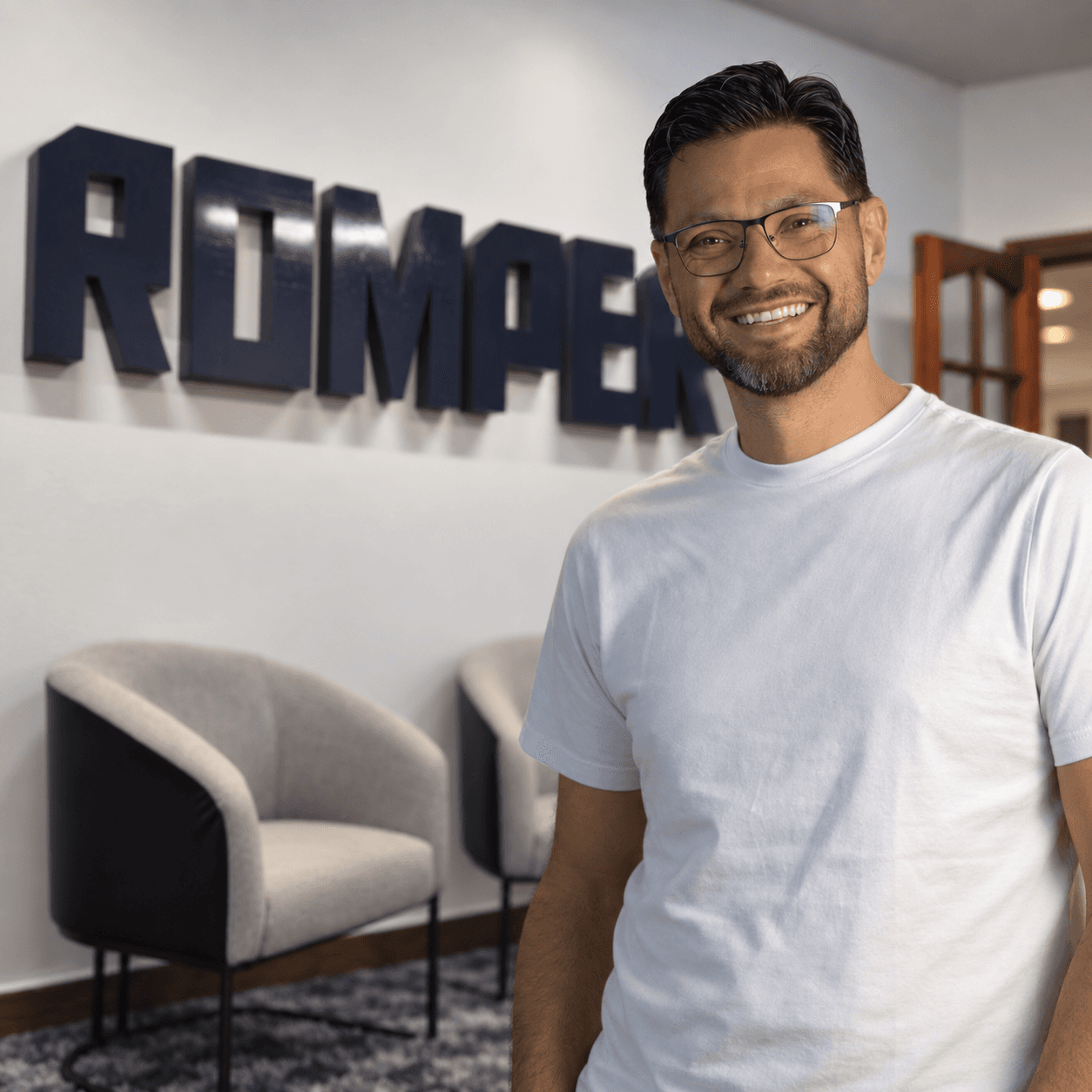
Marlon Rihayem
Founder of the Romper GroupRuns the consulting and the Go/No-Go verdict. He lives in Paraguay, invests here and is setting up his own group's factory: when he says the numbers do not add up, he has already run those numbers with his own money.
He is also the one who says the nos on this page in public, on the channel 700,000 people follow.

Marco Sotana
Lawyer · scope and agenciesHe answers for the scope of the contract and for the legal handling before the agencies: what Romper signs, in what order, under what conditions, and what stays out, written in those words.
He is the one your lawyer will talk to when they want to check every line before signing. That is what he exists for at Romper.
We start from the beginning.Always.
Romper does not take on an industrial project started by a third party and stalled halfway: maquila that should not be maquila, a warehouse in the wrong place, a license requested out of order. Not out of pride: because our delivery depends on decisions that have already been made by someone else.
Regime chosen before checking the Mercosur origin, property closed before the licensing, capital committed to an asset that does not enter under the intended regime.
Redoing a structural decision costs more than making it right, and the schedule has already missed the window. The project rarely accepts the investment the correction requires.
A consulting session with Marlon so you understand where the project stalled and what the paths are, including with another implementation company. Continuing the execution is not on the table.
Talking to a consultant, having a quote in hand and doing research is not a stalled project, it is a project at the start. In that case the path is the same as everyone's: decision, numbers and execution, in this order.
Having the money andbeing able to prove the money.
The proof follows the standard of the Paraguayan banking system: balance sheets, trial balance, income tax, invoices, bank statements and documentation of origin. It opens two doors at once: the setup with Romper and the entry of the capital into the country.
Has the capital and the documentation
Eligible project and viable contribution. This is the scenario Romper works with, and it is the one that reaches production.
Has the capital, not the documentation
Without documentary backing the bank does not receive the contribution, and without the contribution there is no setup. The previous step is to organize the documentation at the origin.
Has the documentation, not the capital
The numbers do not add up at any stage: the contribution does not happen and the factory does not leave the drawing board. Better to know now than halfway through the build.
Why Romper requires this before signing: Romper starts executing (formation, licenses, agencies) with the project still underway. We have already put structures in place for operations that later could not move the capital for lack of proof. Today the order is different: first the backing, then the signature, and then the delivery happens from start to finish.
Three legitimate routesfor the money to arrive here.
You open the company and the capital enters through one of these routes. Romper analyzes which is best for your case, assembles the documentation and runs the process with a banking manager Romper trusts.
Capital contribution
Paid into the Paraguayan company, with a documented origin. The most common route in an industrial setup.
Loan
A loan between the parties, with a contract, an interest rate and traceability, useful when the capital needs to return to its origin.
Advance from a foreign client
An advance for a service or an order from a foreign client, documented as a commercial operation.
The handling of the contribution is charged in the first operations. After that the client already knows how to do it alone, and Romper considers that a good outcome.
The timeline shortens with the right protocol.Not with a shortcut.
Romper has built channels of dialogue at the Ministry of Industry and Commerce, at the municipalities and with the intendancies, and uses that for what actually speeds up a licensing process.
What our table solves
- Correct filing on the first attempt
- Licenses requested in the order the agency expects
- Requirement answered in days, not weeks
- Physical presence when the process calls for a person in the room
What it does not do
- Off-the-books payment, in any instance
- Buying time or a position in the queue
- A legal requirement worked around “just this once”
- A guaranteed date in a public agency's name
Romper's entire operation (100% within the law) exists because a factory is a decades-long asset: what is solved off the books today shows up in the audit, in the export and at the bank later. If your plan depends on a shortcut, the first contact already makes no sense, and saying so now saves time on both sides.
Where Romper steps in, and where you command.
Professionalism, here, is stating precisely what Romper signs. What is on this list goes out with our team; what is not stays under your command, said in those words in the proposal, with no fine print and no borrowed promise.
Romper does
- Environmental license
- DINAVISA and sanitary registrations
- Maquila project (Law 7547/2025)
- Incentives project (Law 7548/2025)
- Opinion on free-trade zone
- Handling at the MIC, SUACE and municipalities
- Referral of a customs broker
Can be added to the scope
- Accounting for the operation
- Structuring of the capital contribution
- Search for a warehouse or land
- Construction of your own warehouse
- Migration documentation for the partners
- Recruitment supported by a local partner
Quoted separately, case by case.
Stays with you
- The build and the installation of the machines
- The production layout and the process engineering
- The purchase of equipment and inputs
- The management of the factory and the team
- The day-to-day: HR, purchasing, internet, cleaning
- Company or RUC in Romper's name
- Credit brokerage
- A guaranteed public-agency timeline
Then this ishow it happens.
From the contract to full operation, with each stage in the order the agencies expect, and with you knowing where the project stands, always.
Outside Greater Asunción,we do not do it.
Industrial implementation support exists within a radius of 120 km of our office in Mariano Roque Alonso, Greater Asunción. Outside that radius Romper does not implement and does not follow up, not for a large project, not out of insistence.
In the first two years, each license, each permit, each inspection and each standardization adjustment calls for someone with a foot in the factory, the same day, not the following week. A consultant 400 km away does not deliver that, and Romper does not sign what it cannot follow up closely.
The rule applies to any point beyond 120 km, with no exception for size. In those cases the most professional thing Romper does is say so now, with no half words: your build will need a company based in the region, and that choice is yours; Romper does not refer a provider it cannot follow up. Consulting and Diagnosis still apply to all of Paraguay: the refusal is of the implementation support, not of the country.
Starting atUS$ 3 million in annual revenue.
It is the band where the move pays for itself: below it the payback stretches so much that the project itself usually stops along the way, and a project stopped halfway costs more than one never started.
Smaller operations have a path in Paraguay, just not with the follow-up structure this service delivers. Consulting with Marlon and the Diagnosis remain available.
What it costs to find out early.
A meeting with the founder repositions the project, the order and the expectation, or shows that Paraguay is not the place for your product.
Origin, regime, licenses, capital and schedule in conservative, base and stress scenarios. With US$ 1,000 in credit at Romper.
Warehouse in the wrong place, a regime that does not fit, an origin that does not qualify: the capital gets stuck before the first export.
This is all stage 1 and stage 2 do: turn an industrial decision into closed numbers. Mercosur origin, NCM, tax regime, environmental license, agency timeline and working capital stop being guesswork and become a spreadsheet line, with the signature of those who operate in Paraguay every day.
Go/No-Go Diagnosis
- Scenarios with YOUR numbers
- Mercosur origin and NCM: gate number one
Industrial Implementation Support
- Licenses, regime and agencies run by Romper
- Scheduled by delivery capacity, not by slots
About the schedule: Romper does not work with a fixed number of slots, but with delivery capacity. A large project can take up the whole year; medium projects, up to eight. We have already turned down large-scale industries by understanding the size of what was at stake, and that was the most professional decision available. 2026 is closed to new starts; the current queue is February 2027. The Diagnosis remains open.
The questions that come in before the first dollar
Direct answers, and when the answer is no, it comes just like that.
Is the US$ 4,500 Diagnosis mandatory to hire the support?
How long does the Diagnosis take?
How do I hire the Diagnosis?
How does the US$ 1,000 credit work?
Do you recommend maquila?
My factory would be 300 km from Asunción. Do you serve there?
I started the project with another consultant and it stalled. Do you take it on?
Do I need to live in Paraguay to have the factory here?
Can I get credit or incentives from the Paraguayan government to finance the factory?
How long until the factory operates?
Can a license be sped up by other means?
The next machine you movecould be the right one.
Start with the decision, follow with the numbers and set up with people who live 40 minutes from your factory.